In an era when skilled labor is scarce and resource costs are rising, the margin for error in the greenhouse is shrinking, making modern growing a balancing act.
The Quantified Sensor Technology portfolio addresses these challenges by making the "invisible" visible. By integrating seamlessly with major platforms, these sensors provide the granular root-zone, climate, and plant-vitality data needed to de-risk and drive efficiency.
It all starts with the FireFly - Climate Monitoring & Data Communication Hub
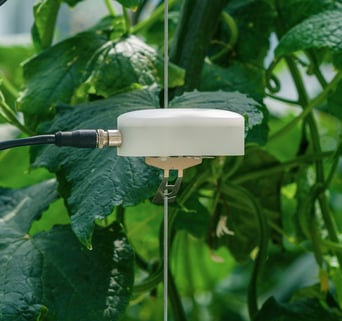 The FireFly sensor node is the foundation of the Quantified portfolio, with two main functions:
-
As an environmental sensor, the FireFly can monitor temperature, relative humidity, derived PAR, and barometric pressure.
-
The FireFly also acts as a communication hub for Quantified’s suite of external sensors, transmitting data wirelessly at 915 MHz to a LoRa gateway, which uploads to the Insight platform.
Built for greenhouse environments, the FireFly features an IP67 rating and is rechargeable with an average battery life of twelve months.
Granular data, directly to your systems - Integration Capabilities
Data is only valuable to growers if it is accessible. The Quantified ecosystem is designed to fit into the existing mid and high-tech greenhouse technology stack, rather than creating a new data silo.
The InSight Platform: Growers can view data, create sensor groups, and set alarm notifications directly through the Quantified Insight platform.
-
Seamless Integration: For facilities running advanced climate computers or data platforms, data can be parsed via the Insight API. It is compatible with major industry platforms, including Priva, LetsGrow.com, Source.ag, and IIVO.
-
How Customers Use It: This allows growers to visualize microclimate or root-zone data in parallel with climate computer settings, enabling unified decision-making for fertigation and climate strategies.
Key Wireless Sensors
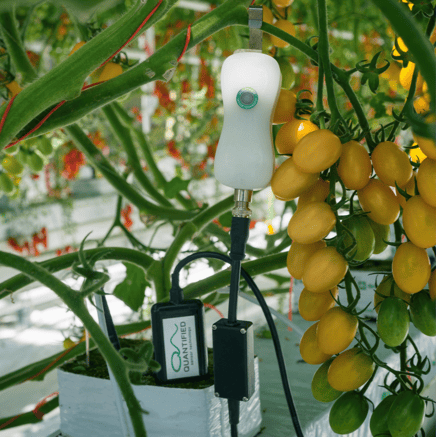
The Poseidon WET Sensor: Precision at the Root Zone
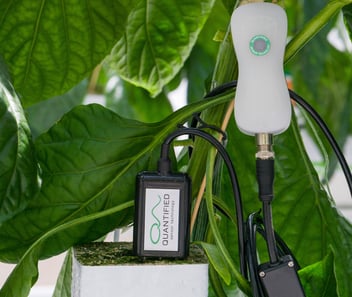
Managing the root zone without accurate data is essentially guesswork. The Poseidon WET Sensor eliminates this uncertainty by measuring three critical variables directly in the substrate or soil: volumetric water content (via dielectric permittivity), electrical conductivity (EC), and temperature.
-
Resource Use-Efficiency: By continuously tracking volumetric water content (VWC), the Poseidon sensor allows you to steer crop development based on actual nutrient uptake rates rather than static estimates. This ensures that your water and fertilizer inputs align with plant demand.
-
Vitality Insights: The sensor provides specific insights into the root zone conditions, which are critical for maintaining healthy root development in substrate slabs, blocks, or pots.
-
Custom Calibration: Because the relationship between permittivity and water content varies soil/substrate type, the Poseidon can be calibrated specifically for your substrate, ensuring high accuracy.
The Smart Gutter: Validating Your Fertigation Strategy
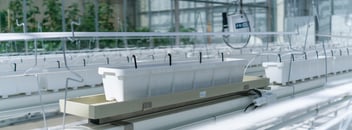
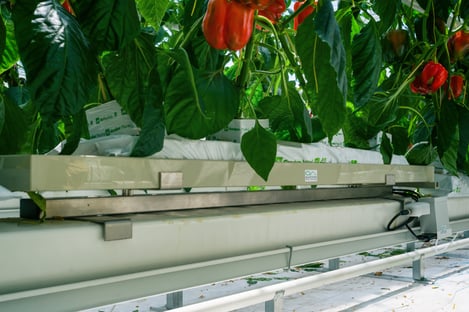
Your irrigation strategy might look perfect on the climate computer, but mechanical realities can differ. The Smart Gutter acts as a validation engine for your irrigation strategy, applicable to cultivation in substrate slabs or multiple small pots.
-
Risk Monitoring & Mitigation: The Smart Gutter confirms that fertigation plans are executed correctly by detecting mechanical failures. It can identify clogged drippers or valve failures, allowing you to react before the crop suffers.
-
Comprehensive Data: Every five minutes, it measures substrate weight, drain volume, drain EC, and drain temperature.
-
Optimized Input Use: By monitoring drain volume and EC in real-time, you can prevent invisible salt accumulation and root stress, ensuring that your drain strategy is both effective and resource-efficient.
The Infrared Thermometer: Detecting Stress Before Symptoms Appear
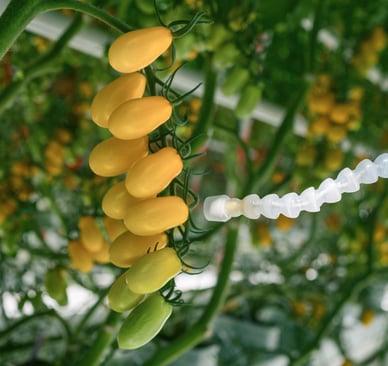
Standard air temperature sensors measure the environment, but they don't always reflect what the plant is experiencing. The Infrared Thermometer connects to the FireFly node to provide non-contact surface temperature measurements of leaves or fruits.
-
Plant Vitality & Stress Detection: This sensor is specifically used to detect plant stress and monitor Vapor Pressure Deficit (VPD). By identifying the “fever” of stomatal closure, you can detect early stress responses.
-
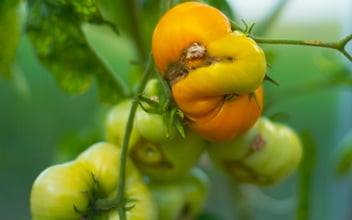
True Plant Temperature: While your climate computer reports air temperature, the IR sensor measures the plant’s surface temperature. This is essential for preventing quality issues like burning or uneven ripening.
-
Risk Mitigation: This data allows you to proactively prevent issues from both biotic and abiotic stress by making corrections before physical stress symptoms appear.
The Bottom Line
Deploying additional sensors isn’t just about collecting more data; it is about unifying diverse metrics into clear indicators for better decision-making. Whether you are looking to optimize input use, conserve labor, or proactively mitigate risks, these tools provide the wireless insights necessary to "grow more, using less".